Did you know that Taco Bell was voted the best fast-food restaurant in the U.S. recently? It’s true! And honestly, I get it. Back in the day, nothing hit the spot quite like a late-night drive-thru run for a certain hexagonal packet of joy. But let’s be real—sometimes you just don’t want to leave the house, or you crave ingredients you can actually pronounce.
That’s exactly why we’re ditching the mystery meat today. In this post, we are going to build a vegan crunchwrap that hits every single flavor note: savory, spicy, creamy, and crunchy. It’s way easier than you think to pull off at home! Ready to change your movie nights forever? Let’s get cooking!
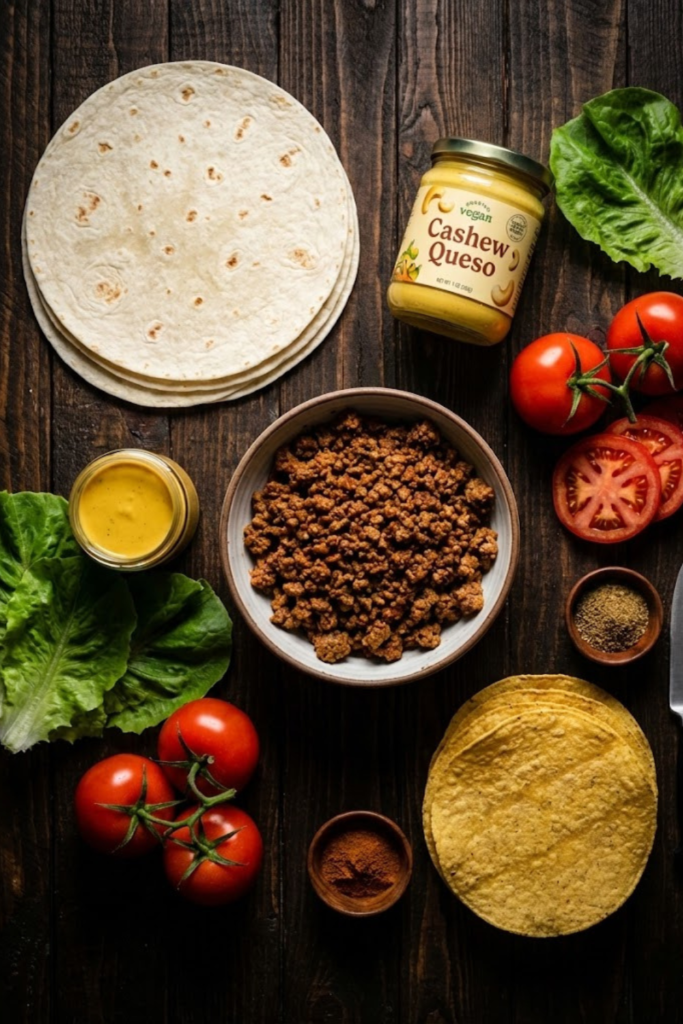
Essential Ingredients for a Plant-Based Crunchwrap
I have to be honest with you—my first attempt at making this iconic fast-food copycat was a total disaster. I stood in my kitchen, staring at a pile of mush that refused to stay inside the tortilla. It was heartbreaking. I had used the wrong size wraps, my “cheese” was essentially yellow water, and the whole thing fell apart the second it hit the pan.
But hey, you live and you learn, right?
After way too many trial runs (and a lot of messy countertops), I finally cracked the code. The secret isn’t just in the folding technique; it is 100% about using the right stuff. You can’t just throw random leftovers in a wrap and pray for the best.
Here is the rundown of exactly what you need to make a vegan crunchwrap that actually holds together.
The Foundation: Go Big or Go Home
This is the hill I will die on. You absolutely need “Burrito Size” or “Extra Large” flour tortillas. Do not try to be a hero with those standard soft taco shells.
I once tried using regular 8-inch tortillas because that’s all the store had. Big mistake. I ended up with a tiny, open-faced sad taco instead of a sealed wrap. You need that extra surface area to pull off the pleating maneuver later. If your grocery store has a bakery section, grab the fresh ones—they are usually stretchier and less prone to cracking.
The Protein: Ditching the Beef
For the “meat” layer, you have a few solid options. Personally, I am obsessed with a homemade lentil and walnut mix. It sounds weird if you’ve never tried it, but the texture is spot-on. It gives you that savory, crumbly mouthfeel that mimics ground beef perfectly.
If you aren’t into nuts or just want to save time, a bag of frozen vegan ground beef alternative works wonders. Just make sure you season it heavily. Store-bought crumbles can be kinda bland on their own.
The Cheesy Goodness
We cannot talk about a crunchwrap without talking about the liquid gold. Dairy-free nacho cheese has come a long way, but some brands still taste like plastic. I usually prefer making a quick cashew-based queso because it gets super gooey.
However, if you are pressed for time, look for a potato-and-carrot based cheese sauce at the store. Just avoid the shreds for this specific layer—you really want a sauce that spreads evenly and acts like glue for the tostada.
The Crunch Factor (The MVP)
This is the most critical part. You need flat corn tostada shells. They create that solid barrier between the hot meat and the cold lettuce, keeping everything from turning into a soggy mess.
I remember one time I couldn’t find tostadas, so I just used a handful of tortilla chips. The flavor was there, but the structural integrity? Gone. The chips shifted around, and slicing it was a nightmare. The flat tostada provides the stability you need to hold this beast with one hand.
Fresh Toppings
Finally, keep it classic with shredded lettuce, diced tomatoes, and a dollop of vegan sour cream. I like to mix a little hot sauce into my sour cream for a kick.
Get your ingredients prepped and laid out before you even turn on the stove. This thing cooks fast, and you don’t want to be chopping tomatoes while your tortilla burns!
How to Make the Perfect Vegan Taco Meat
Okay, let’s get real for a second. The biggest complaint I hear about plant-based food is that the texture is “mushy.” And honestly? I get it. I remember the first time I tried to make vegan taco meat just using plain boiled lentils. It was… an experience. A bad one. It felt like eating baby food wrapped in a tortilla. Not exactly appetizing.
But I refused to give up. After ruining a few dinners and getting some serious side-eye from my family, I realized that texture is everything. You can’t just rely on one ingredient.
Mastering the Texture
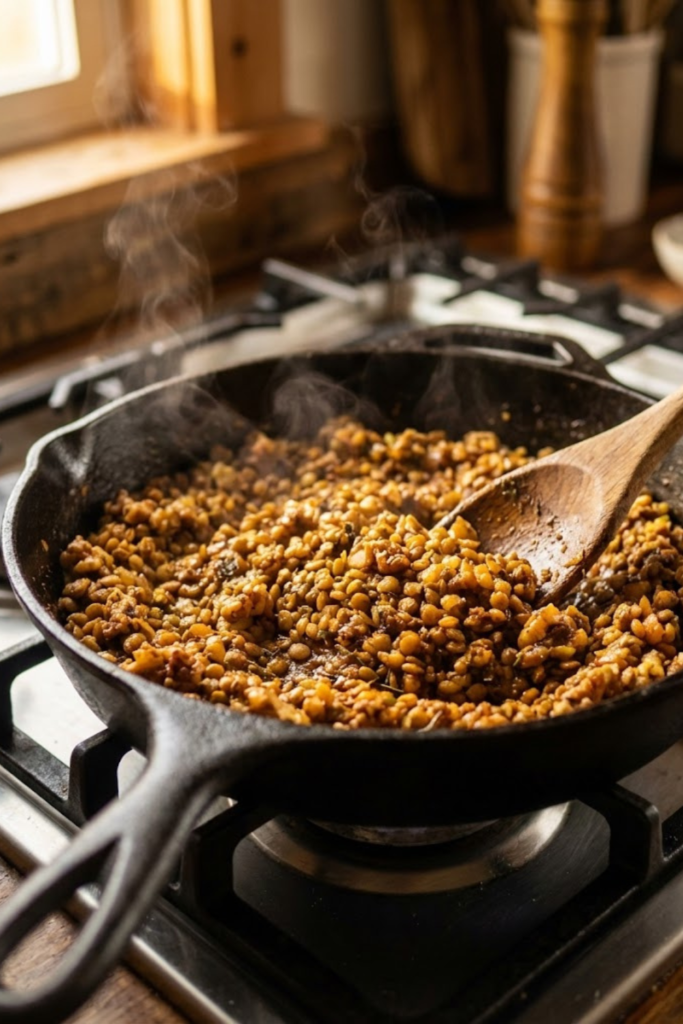
Here is the trick I learned the hard way: you need a combination of soft and crunchy. My holy grail method uses a mix of lentils and raw walnuts.
I know, putting nuts in your taco sounds bizarre. But trust me on this. When you pulse walnuts in a food processor (don’t turn them into butter, just coarse crumbs!), they add a fatty, rich bite that mimics beef incredibly well.
I usually do a 50/50 split of cooked lentils and crushed walnuts. If you are allergic to nuts, you can swap them for roasted sunflower seeds or even crumbled firm tofu that’s been baked first. The goal is to avoid a bowl of slush.
The Spice Blend Situation
Please, for the love of flavor, step away from the pre-packaged seasoning packets. They are usually loaded with salt and weird fillers. Making your own homemade taco seasoning takes literally two minutes.
I learned this lesson when I made a batch so salty it was inedible. Now, I control the salt. My go-to mix is heavy on the chili powder, cumin, and smoked paprika. That smoked paprika is the secret weapon—it gives you that “grilled” flavor without needing a grill.
Cooking It Down
When you throw this into the pan, don’t just warm it up. You need to actually cook the spices. I always start by sautéing a diced yellow onion until it’s translucent. Then I toss in the garlic for just 30 seconds.
I used to burn the garlic constantly because I’d throw it in too early. Don’t be like me. Burnt garlic tastes bitter and ruins the whole vibe.
Once the aromatics are ready, add your lentil-walnut mix (or whatever plant-based protein you picked) and the spices. Toasting the spices with the “meat” before adding liquid wakes up the flavors.
Moisture Control is Critical
This is where a lot of people mess up their vegan crunchwrap. If the filling is too wet, your tostada shell will get soggy instantly. If it’s too dry, it’s like eating sand.
You want it to be “sticky.” I add a tablespoon of tomato paste and a tiny splash of vegetable broth. Simmer it until the liquid is mostly gone but the mixture holds together. It should look juicy, not soupy. This ensures that when you bite into the wrap, the filling stays put instead of dripping down your arm.
The Art of the Hexagon Fold (Step-by-Step)
This is the moment of truth. You have prepped all your delicious fillings, your kitchen smells amazing, and now you have to actually build the thing. I’m not going to lie to you—my first few attempts looked less like a hexagon and more like a sad, lopsided envelope.
I distinctly remember trying to force the edges together on an overstuffed wrap, watching the tortilla tear right down the middle. I may or may not have yelled at the counter. But don’t worry, once you get the rhythm down, it’s actually pretty satisfying.
Layering Order Matters
There is a science to the architecture here. You can’t just throw things in willy-nilly. The goal is to keep the crunchy part crunchy and the hot part hot.
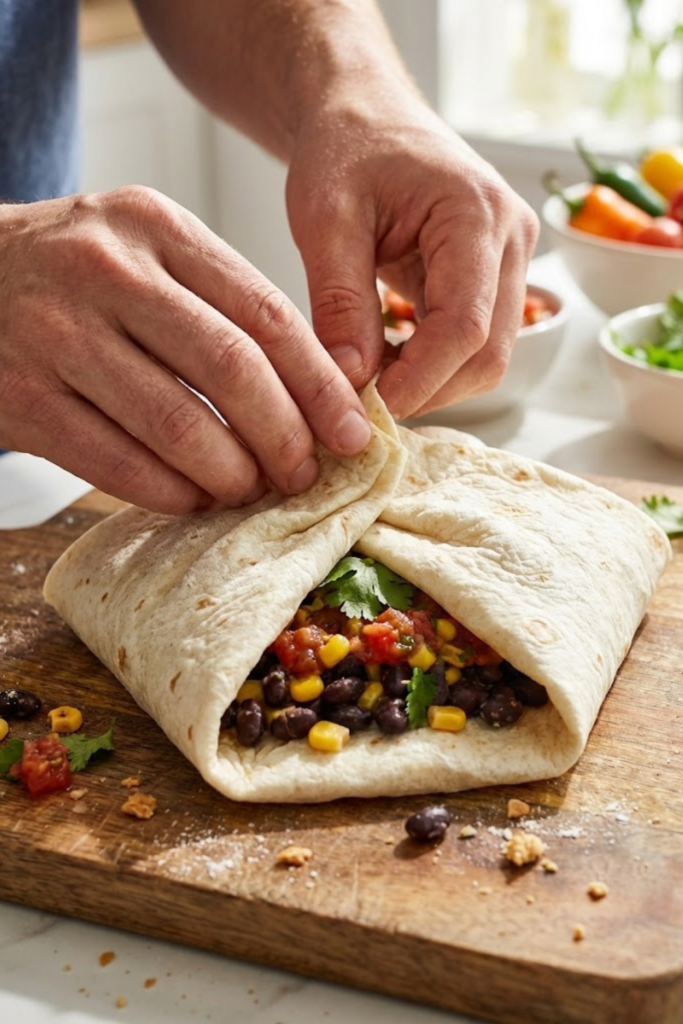
Start with your large flour tortilla on a flat surface. Place a scoop of your warm vegan taco meat right in the center. Drizzle your cheese sauce over the meat. Now, place the tostada shell directly on top of the meat and cheese.
This is the critical barrier. Everything below the tostada is hot; everything above it is cold.
Spread your sour cream on the tostada, then pile on the lettuce and tomatoes. I used to put the sour cream on the meat layer, and it just melted into a gross puddle. Learn from my mistake: keep the cool toppings on the “roof” of the tostada.
The Cutout Hack
Here is the secret weapon that changed everything for me. Even with a large tortilla, you usually end up with a gaping hole in the middle where the edges don’t quite meet.
Take a smaller, taco-sized tortilla (or cut a circle out of a scrap tortilla) and place it right on top of the lettuce. This acts as a seal. Without this little patch, your lettuce falls out, and the whole crunchwrap folding technique fails. It felt like cheating when I first did it, but it works flawlessly.
The Pleating Motion
Now for the origami part. Start at the bottom of the large tortilla and fold the edge up over the center. Hold it there with one hand. With your other hand, grab the next section of the tortilla edge, pull it tight towards the center, and fold it over.
You want to aim for about 5 or 6 nice, tight pleats. It helps to think of it like wrapping a weirdly shaped gift. Keep your hand on the center the entire time to hold the folds down.
Holding It Together
This is the stressful part. You have this beautiful hexagon under your hand, but if you let go, it explodes. You have to move fast.
I’ve found that you don’t need toothpicks or water to seal it. Just trust the weight of the wrap. The second you finish that last fold, prepare to flip it. You are going to transfer it to the pan immediately.
Don’t let it sit on the counter folded for too long, or the tortilla might start to crack at the seams. Speed is your friend here!
Cooking and Serving Your Copycat Crunchwrap
This is the home stretch. You have successfully folded your wrap, and now you are holding it together like a fragile secret. The transfer from the counter to the pan is the most nerve-wracking part of this entire process.
I have definitely dropped one on the floor before. My dog was thrilled; I was not.
To avoid disaster, slide a wide spatula under the wrap while keeping your hand on the folds. You need to be confident. Hesitation is the enemy here!
Seam Side Down: The Golden Rule
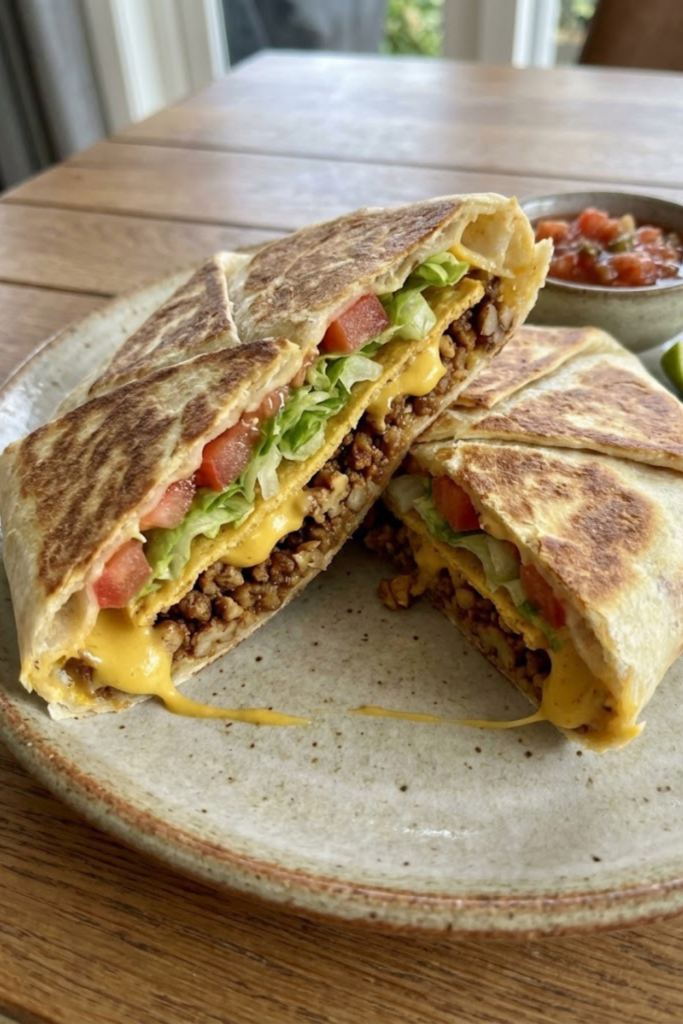
I cannot stress this enough: you must place the wrap seam-side down in the skillet first. If you place it smooth-side down, the folds will pop open as they heat up, and you’ll end up with a deconstructed vegan crunchwrap. Which is just a fancy way of saying “messy tacos.”
Press it down gently with your spatula. You want to hear that sizzle. This sears the folds together, sealing the hexagon shut. It’s like magic. Once that bottom is crispy (usually about 3 to 4 minutes), it’s safe to flip.
Managing the Heat
Here is where I used to mess up big time. I’d crank the heat to “High” because I was hungry and impatient. The result? A burnt, black tortilla on the outside and cold, unmelted cheese on the inside.
Patience is key. Keep your skillet on medium-low heat. This gives the heat enough time to penetrate through the tostada shell and melt that cheese sauce without scorching the flour tortilla. You want a golden-brown color, not charcoal.
The Flip and Serve
When you flip it over, it should be rigid and hold its shape. Cook the other side for another 3 minutes. It should sound hollow and crispy when you tap it with your spatula.
Slice it in half immediately. Hearing that crunch as the knife goes through the tostada is honestly the best sound in the world.
For serving, I am a dipper. I need sides. I love pairing this with a spicy green salsa or even extra cashew queso. If you want to feel a little healthier, a side of cilantro-lime rice or a simple corn salad works great to balance out the richness of the vegan comfort food.
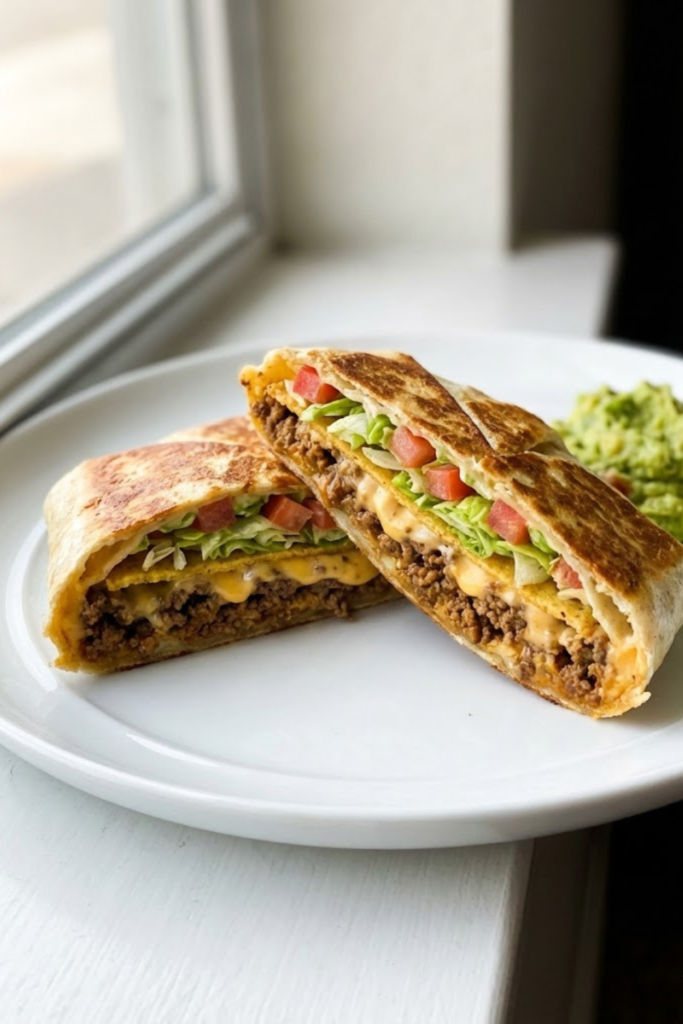
There you have it! A vegan crunchwrap supreme that is cheesy, crunchy, and satisfyingly messy. It really is proof that you don’t need animal products to enjoy your fast-food favorites.
I know it looks like a lot of steps, but once you get the hang of the folding, you will be making these on repeat. It is the ultimate Friday night treat.
Give this recipe a try this weekend. I promise, your tastebuds (and your wallet) will thank you!
Don’t forget to save this recipe to your “Vegan Comfort Food” board on Pinterest!