Did you know that 90% of cookie decorating failures happen because of consistency, not skill? I learned that the hard way! There is nothing—and I mean nothing—more frustrating than watching your cute bunny turn into a melted blob in the oven. But hey, we are fixing that today! I’ve spent years perfecting a recipe that stays sharp and tastes incredible. Whether you are a total newbie or looking to up your baking game for Easter 2026, this guide is your new best friend. We are going to tackle everything from rolling dough to that satisfying “pop” of smooth icing. Let’s get baking!
Essential Tools and Ingredients for Perfect Cut-Out Cookies
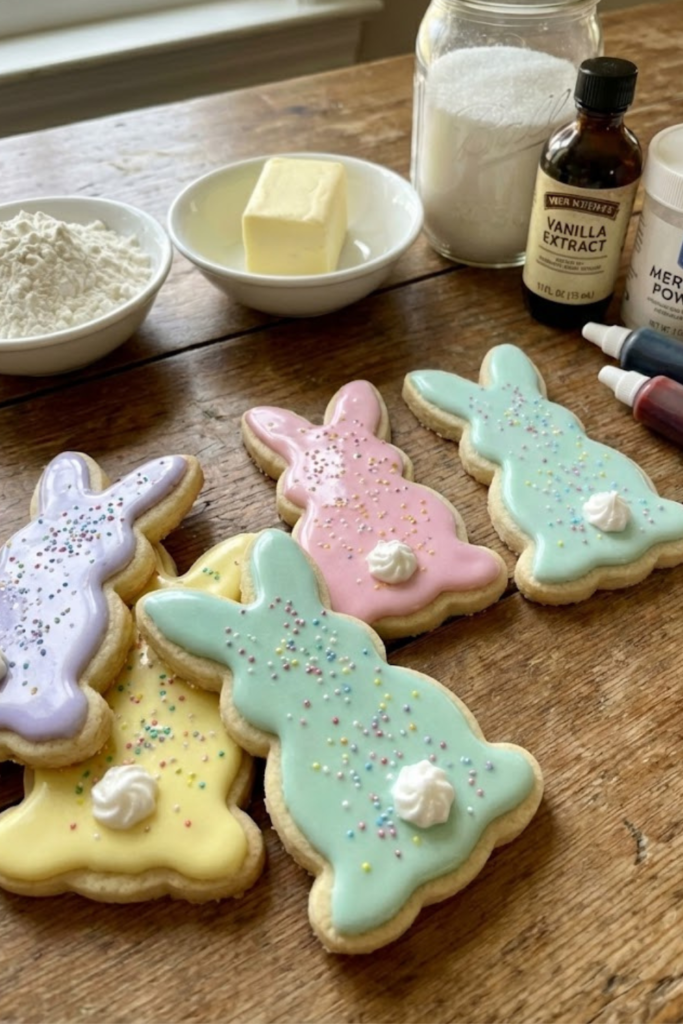
I used to think that making Easter Bunny Sugar Cookies with Royal Icing was all about being a good artist. I was wrong. Honestly, 90% of the battle is just having the right stuff in your kitchen before you even crack an egg. I remember trying to make these for a school bake sale about ten years ago using cheap plastic cutters and liquid food coloring from the grocery store.
It was a disaster. The bunnies looked like blobs, and the icing never dried. I cried a little bit, I won’t lie. But after years of trial and error, I’ve figured out exactly what you need to avoid that mess.
The Cutter Controversy: Metal vs. Plastic
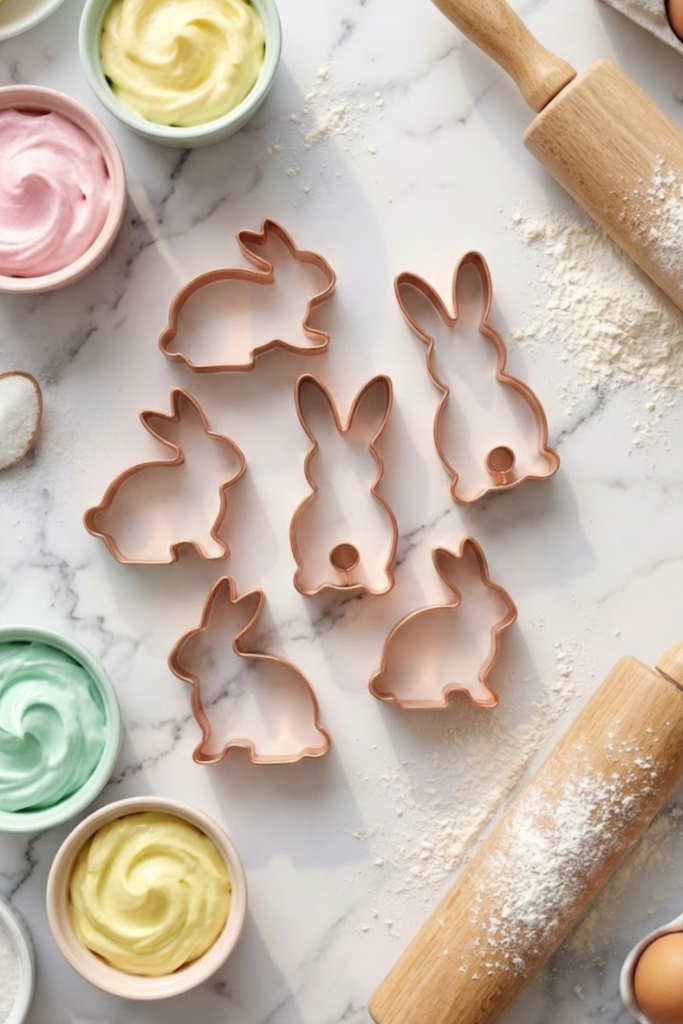
You might think a cookie cutter is just a piece of plastic, but it actually makes a huge difference. I learned this the hard way when my bunny ears kept tearing off.
Plastic cutters are often too thick at the bottom. They don’t cut through the dough cleanly, which leads to ragged edges that burn in the oven. You really want to grab some sturdy metal cutters. They give you that sharp, clean line that makes the cookie look professional right off the bat. Plus, they don’t bend when you press down on cold dough.
Why Butter Temperature is Everything
Okay, let’s talk about butter. If you take anything away from this, let it be this: temperature matters. For the dough, you want your butter to be room temperature, but not melty.
If it’s too soft, your cookies will spread all over the pan and lose their shape. I usually take mine out of the fridge about an hour before I start. You should be able to press your finger into it and leave a dent, but it shouldn’t be greasy.
The Magic of Meringue Powder
For the icing, stop using raw egg whites. Just stop. It’s messy, and frankly, it kinda worries me with food safety. Meringue powder is the secret weapon for perfect Easter Bunny Sugar Cookies with Royal Icing.
It’s basically dried egg whites with some stabilizers. It makes your icing whip up faster and, most importantly, it creates that hard, shiny finish that allows you to stack the cookies without smashing them. I accidentally bought a “meringue mix” once instead of pure powder—don’t do that. Look for high-quality meringue powder specifically for baking.
Gel Colors vs. Liquid Drops
Here is where I messed up for years. I used those little tear-drop shaped liquid colors you get in the 4-pack.
The problem is that royal icing is super sensitive to water. If you add liquid color to get a nice bright pink, you are watering down your icing. Then it runs off the cookie. You need to use gel paste colors. They are super concentrated, so you only need a tiny toothpick amount to get vibrant colors without ruining your icing consistency. It saves you so much headache later!
The Secret No-Spread Sugar Cookie Dough Method
There is nothing worse than cutting out a perfect little bunny, putting it in the oven, and pulling out a fat blob that looks like a cloud. I have been there so many times. It took me a while to figure out why my Easter Bunny Sugar Cookies with Royal Icing kept losing their shape.
It turns out, the recipe is important, but how you treat the dough is even more important.
The Chill Time Rule
You can’t rush this. I know you want to eat the cookies right now, but you have to be patient. I use a “double chill” method. First, after I mix the dough, I wrap it in plastic and put it in the fridge for at least an hour. This lets the butter firm up again.
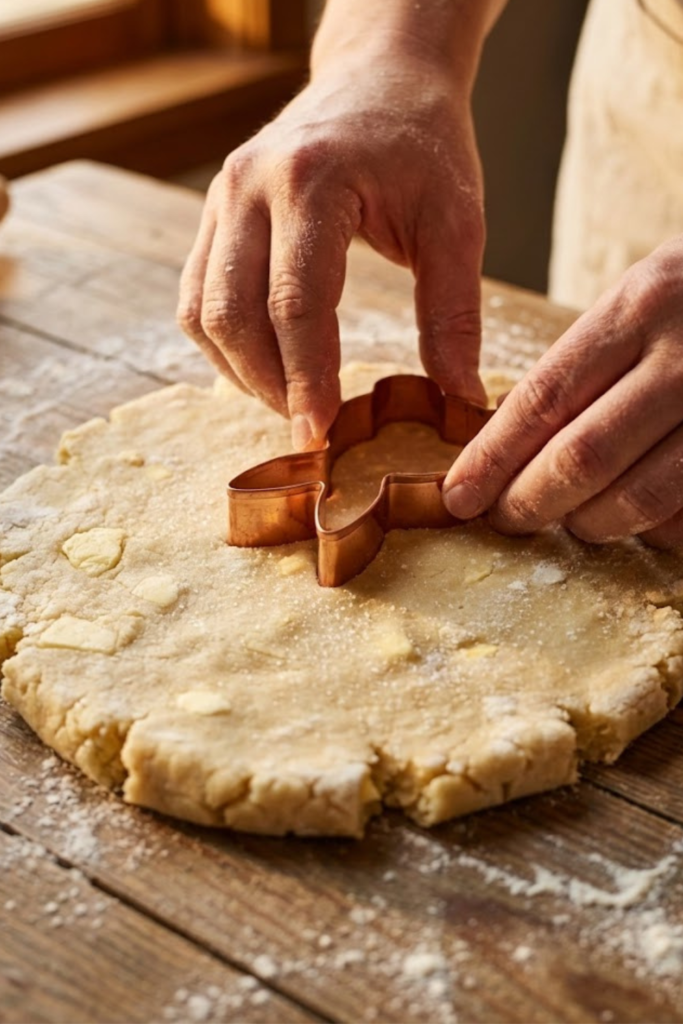
But here is the real secret: after I roll out the dough and cut out my bunny shapes, I put the whole baking sheet back in the fridge for 10 minutes before baking. If the butter is cold when it hits the hot oven, the cookie sets its shape before the butter has time to melt and spread.
Rolling Thickness Tips
For years, my cookies were lopsided. One side was thick and soft, the other was thin and burnt. Then I bought a rolling pin with guide rings. They are these little plastic circles you put on the ends of your rolling pin.
I use the 1/4-inch rings. This makes every single cookie exactly the same thickness. It helps them bake evenly so you don’t end up with burnt ears and a raw tummy.
Flavor Variations
Plain sugar cookies are okay, but they can be a little boring. I like to add a little something extra. I almost always swap half of the vanilla extract for almond extract. It gives it that “bakery” taste that everyone asks about.
If you want something fresh for spring, grating a little lemon zest into the sugar before you mix it with the butter makes a huge difference.
Troubleshooting Sticky Dough
If your dough is sticking to the counter, don’t just keep adding flour. If you add too much flour, the cookies get tough and taste like cardboard. Instead, roll your dough out between two sheets of parchment paper. You won’t need any extra flour, and it makes cleanup super easy.
Mastering Royal Icing Consistencies: Flood vs. Stiff Peaks
This is it. The boss level. Making the dough is easy compared to this. Getting the icing right is the difference between a cookie that looks like it came from a bakery and one that looks like a sticky mess.
For the longest time, I just mixed powdered sugar and water and hoped for the best. It was always either too runny and dripped off the sides, or too thick and looked chunky. I finally learned that you actually need two different types of icing for the same cookie.
The 15-Second Consistency Test
This is the golden rule for “flood” icing—the stuff that fills in the middle of the cookie. You want it to be smooth like shampoo.
Here is how I test it: I take a knife and drag it through the icing in the bowl. It makes a little line. Then I count. If the line disappears in exactly 15 seconds, it’s perfect. If it disappears faster, it’s too thin (add more sugar). If it takes longer, it’s too thick (add water, literally one drop at a time).
Piping Borders
You can’t just dump the flood icing on the cookie. It will run everywhere. You need a “dam” first. This is your outline.
For this, I keep some of my icing thicker, like the consistency of toothpaste. When you pipe it, it should hold its shape and not spread out. I usually put this in a piping bag with a small round tip. I trace the shape of the bunny ears and body first.
Mixing Colors Without Bleeding
Have you ever made a white bunny, put a cute pink nose on it, and came back an hour later to find a pink stain spreading into the white? That is color bleed.
It usually happens because the icing is too thin or you live in a humid place. My trick is to use less water in my dark colors. Also, I let the white base dry for about 20 minutes before I add the dark details on top. It acts like a little barrier.
Storage Hacks
Royal icing dries fast. Like, really fast. If you leave your piping bag open on the counter for five minutes, the tip will crust over and get clogged. It is so annoying trying to squeeze a clogged bag.
I always keep a damp paper towel next to me. Whenever I set a bag down, I wrap the tip in the damp towel or put it in a cup with a wet sponge at the bottom. It keeps the icing flowing nicely.
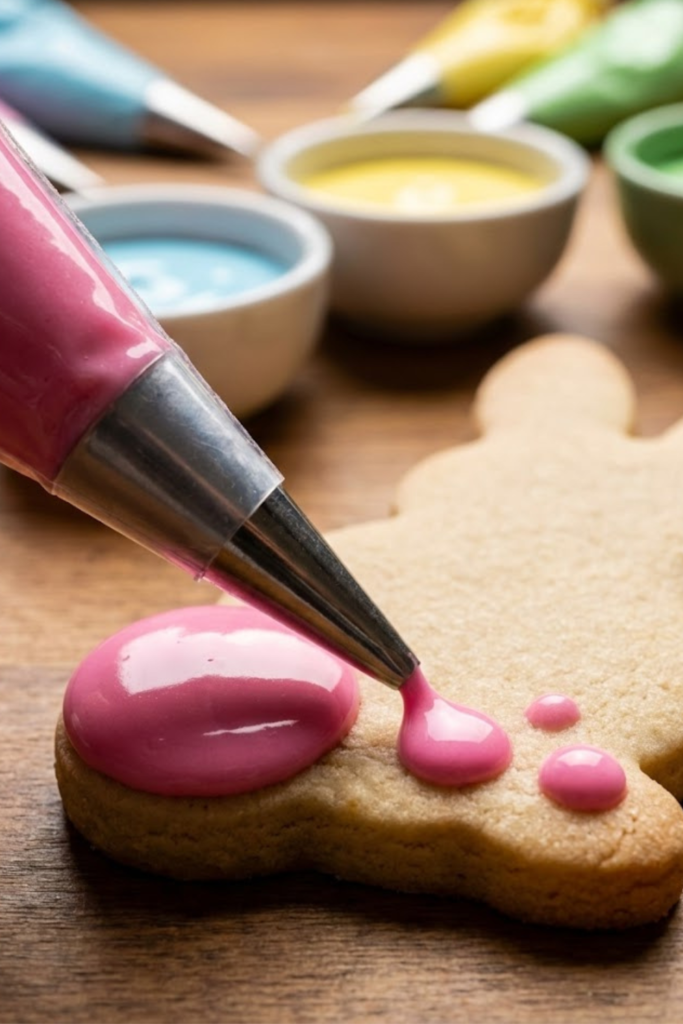
Step-by-Step Decorating Techniques for Easter Bunnies
Okay, class is in session! Just kidding. But really, this is where the magic happens. We have our baked cookies and our icing is ready. Now we are going to make them look like actual bunnies and not just white blobs.
I used to try to do everything at once and it was a disaster. You have to take it in steps.
The “Wet-on-Wet” Technique
This is my favorite trick because it looks fancy but it is actually super easy. Basically, you put wet icing on top of other wet icing.
So, let’s say you want to give your bunny pink polka dots on its ears. You flood the ear with white icing first. Then, immediately while it is still wet, you drop tiny dots of pink icing right into the white. The pink sinks in and becomes flat and smooth. It looks like a printed pattern! You have to be quick though. If the white starts to crust over, the pink will just sit on top and look bumpy.
Adding 3D Details
For things like the fluffy tail or the nose, you want those to pop out. You don’t want them flat.
Here is what I do: I flood the whole bunny body white and let it dry for about an hour. It needs to form a crust. Then, I come back with my white icing and pipe a little circle for the tail. Because the bottom layer is dry, the new icing sits on top and looks like a puffy little cotton ball. I do the same for the nose and the inner ears. It gives the Easter Bunny Sugar Cookies with Royal Icing some nice texture.
Using Sprinkles and Edible Markers
Listen, sometimes I just don’t have the energy to pipe tiny eyes. My hand gets shaky and my bunnies end up looking cross-eyed or scary.
Edible markers are a lifesaver. I buy the black ones with a fine tip. Once the icing is completely hard (like, rock hard), I just draw two little dots for eyes and some whiskers. It takes two seconds. Also, if you mess up piping a tail, just dump some white sprinkles on it while it’s wet. It looks furry and hides any mistakes.
Drying Time
This is the part everyone hates. You cannot stack these cookies until they are 100% dry. I mean it.
Surface dry is not the same as dry-dry. The top might feel hard after an hour, but the middle is still like toothpaste. If you put them in a bag, you will squish them. I leave my cookies out on the counter overnight—usually about 8 to 12 hours. It keeps them safe. I usually put a mesh food cover over them so no dust (or cat hair) gets on them.

Well, there you have it. That is pretty much everything I know about making Easter Bunny Sugar Cookies with Royal Icing. It feels like a lot of steps, I know. But once you get the hang of the consistency—remember, that 15-second rule!—it actually becomes really relaxing.
My first batch years ago was a total mess, but my kids still ate them. So don’t be too hard on yourself if they aren’t perfect the first time. The taste is what really matters, right? And these cookies taste amazing with that hint of almond.
If you bake these, I would love to see them! Or if you just want to save this for later, please pin this recipe to your Easter board on Pinterest. It helps me out a ton and makes it easy for you to find it when you are ready to bake. Happy Easter!