I remember the first time I tried to dry fruit in my oven; it was a total disaster that ended with a smoke alarm and some very sad, charred apples. But listen, you don’t need a fancy $300 dehydrator to make something amazing! Did you know that roughly 85% of home cooks actually prefer using their standard oven for small batches of fruit snacks because it’s just faster? These baked pear cinnamon chips are about to become your new obsession. They are sweet, crunchy, and way better for you than those greasy potato chips sitting in your pantry. Let’s get into how we can turn a few humble pears into a gold-standard snack for 2026!
Choosing the Right Pears for Maximum Crunch
I used to think a pear was just a pear, you know? Like, if it’s round and comes from a tree, it’ll work for any recipe. Well, I was totally wrong about that. My first try with this snack was a huge disaster because I picked these super soft Bartlett pears that were basically dripping juice before I even touched them with a knife. They never got crunchy; they just stayed kind of limp and sad on the tray. If you want that satisfying snap when you bite into your baked pear cinnamon chips, you really have to be picky when you are standing in the produce section at the grocery store.
The Best Varieties for Baking
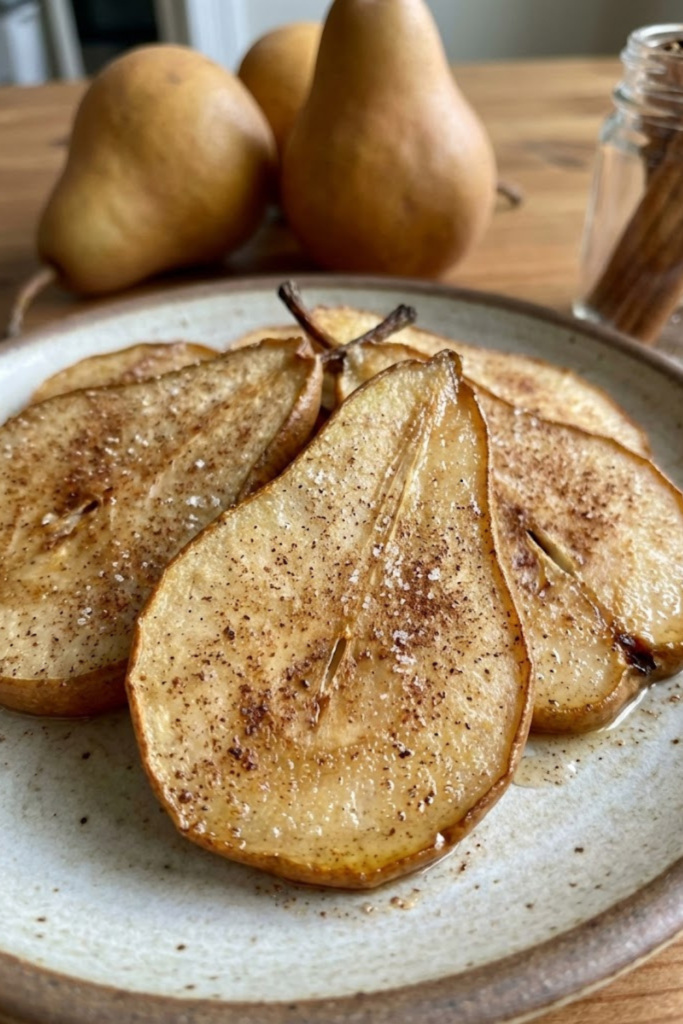
When you’re walking down the aisle, look for Bosc or Anjou pears. Bosc pears are the ones with the long necks and that brownish, papery skin. They are naturally firmer and they hold their shape really well when they get hot. Anjou pears are also great because they have a lot of density. You want a fruit that feels solid in your hand. If you use something like a Comice pear, which is delicious for eating fresh, it has way too much water. All that juice just turns into steam in the oven, and instead of a chip, you get a piece of fruit leather that’s impossible to chew. I learned that the hard way after wasting a whole afternoon!
How to Tell if It’s Ready
Here is a trick I tell everyone: check the neck. You don’t want a pear that’s soft all over. If the “belly” of the pear is soft, it is way too ripe for chips. Instead, give the pear a little squeeze right at the top where the stem is. It should give just a tiny bit, but still feel firm. If it’s rock hard, it might not have enough sugar developed yet. But if it’s mushy at the neck, put it back! You’re looking for that middle ground where it’s sweet but still has some structure.
Why Water is the Enemy
The whole point of making these is to get rid of the water. Pears are mostly water, which is crazy when you think about it. If you start with a fruit that’s already over-ripe, the water content is even higher and the fibers have started to break down. That’s why Bosc is my go-to. The texture is a bit more “sturdy,” which means it dries out into a perfect, crisp disc rather than a sticky mess. Making sure you pick the right fruit is half the battle. If you get this part right, the rest of the process is much easier!
Preparing Your Pears: Slicing and Spicing Secrets
Alright, let’s talk about the actual prep work because this is where most people get bored and start taking shortcuts. I’ve been a teacher for a long time, and I see it with my students all the time—they want to get to the “finished” part without doing the middle part right. But with baked pear cinnamon chips, the middle part is actually the most important part! If you just hack away at a pear with a dull kitchen knife, you’re going to end up with chunks that are thick on one side and thin on the other. When that happens, the thin side burns to a crisp while the thick side stays mushy. It’s just frustrating, and nobody wants to eat a half-burnt snack.
Mastering the Mandoline Slicer
If you want these to look like the ones in the fancy health food stores, you really need a mandoline slicer. I know, I know—they can be a bit scary. The first time I used one, I was being stubborn and didn’t use the safety guard, and let’s just say I had to wear a giant bandage on my thumb for a week. Don’t be like me! Use the guard. You want to set the blade to about 1/16th of an inch. That is the “sweet spot” for getting a chip that actually crunches. If you go too thick, you’re just making dried fruit, which is fine, but it’s not a “chip.” You want them so thin that you can almost see the light through them before they even go in the oven.
Making Your Own Cinnamon Sugar Mix
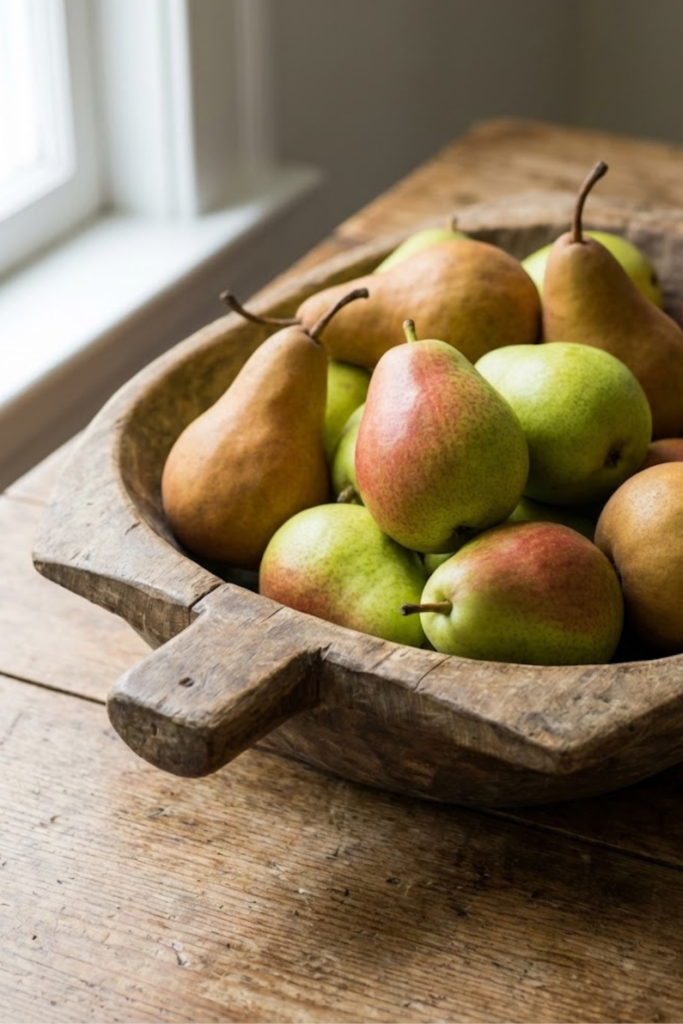
Once you have your neat little piles of pear slices, it is time for the flavor. I like to make a big batch of spice mix in an old spice jar so I can just shake it on. I usually do a quarter cup of sugar and two tablespoons of cinnamon. Some people say you don’t need the sugar, but honestly, it helps with the crunch. The sugar melts a little bit and creates this glass-like coating that is just incredible. Since it’s 2026, I’ve started adding a pinch of cardamom too. It gives the pears a really “expensive” taste without actually costing much. Just a light dusting is all you need; don’t go overboard or the spice will be all you taste.
Avoiding the Clumping Disaster
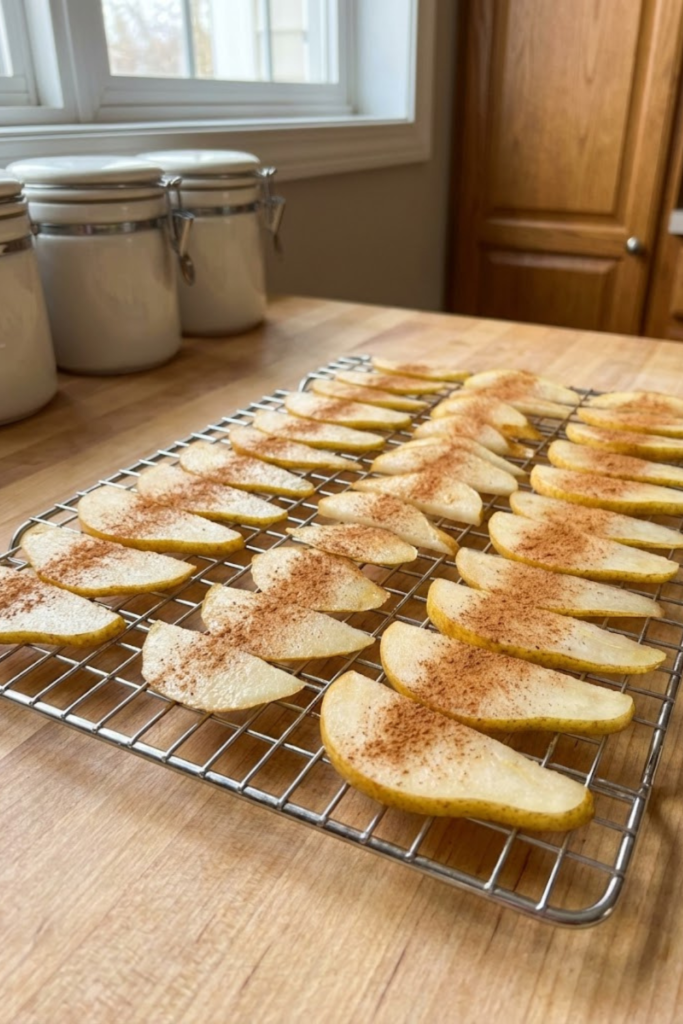
One big mistake I made early on was trying to toss all the slices in a bowl with the cinnamon. That was a mess! The slices are wet, so they all stuck together, and the cinnamon just turned into a brown paste in certain spots. Now, I lay the slices out on the tray first and then use a small sifter or a shaker to get an even coat. It takes an extra minute, but it makes a huge difference. You want every single slice to have its own little “jacket” of spice. This way, every bite you take is exactly as good as the last one. It makes the whole house smell like a candle shop, which is a nice little bonus while you work!
Baking Tips to Avoid Soggy Chips
I’ve spent plenty of Saturday mornings hovering over my oven, just waiting for things to happen. When I first started making baked pear cinnamon chips, I thought I could just crank the heat up to 350 degrees and be done in twenty minutes. I mean, that’s how you bake cookies, right? Big mistake. All I got was a tray of burnt edges and centers that were still as soft as a fresh pear. If you want that crunch that everyone loves, you have to be patient. It’s a lot like teaching a kid how to read; you can’t rush the process, or you’ll just end up with a mess and a lot of frustration.
The Magic of Low and Slow
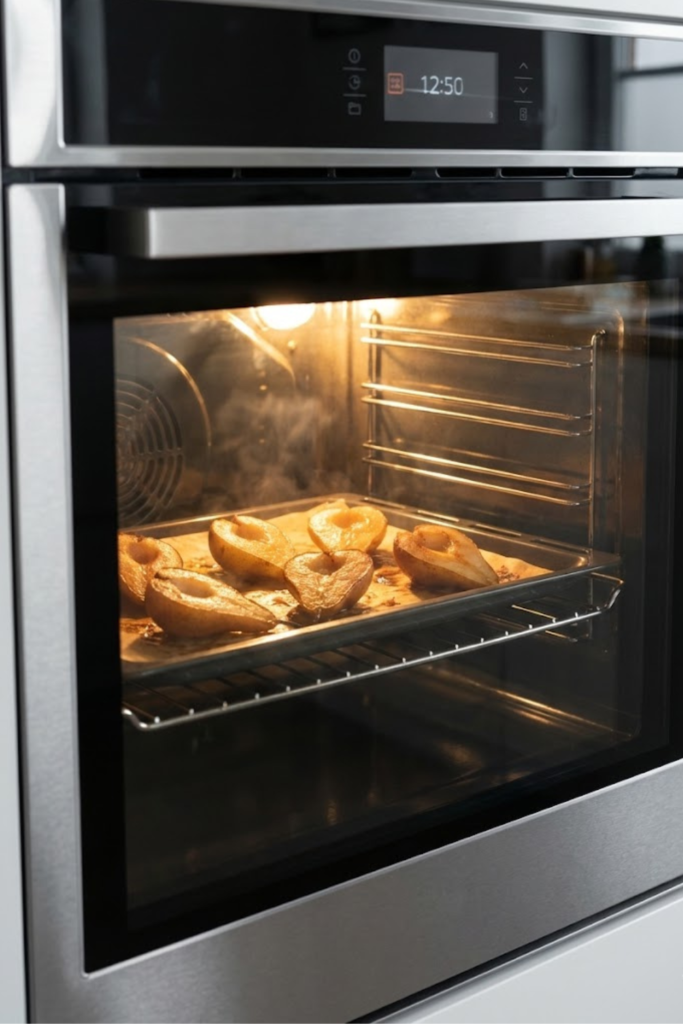
The real secret to getting these right is keeping your oven at a low temperature, usually around 200 degrees Fahrenheit. If your oven has a convection setting, even better, because that keeps the air moving around. You aren’t really “cooking” the pears as much as you are drying them out. I usually clear my schedule for a few hours because this takes time. Depending on how much water was in your pears, it can take anywhere from two to three hours. I like to put a movie on or grade some papers while the oven does its thing. If you try to speed it up by turning the heat up, the natural sugars in the fruit will burn before the moisture has a chance to leave. This low-heat method makes the snack taste sweet without being bitter.
The Flip is Non-Negotiable
About halfway through the baking time, you have to get in there and flip every single slice. I know it’s a bit of a pain, especially if you have two or three trays going at once, but it makes a huge difference. Moisture tends to get trapped between the pear and the tray—or even the wire rack—and flipping them allows both sides to dry out evenly. I usually use a thin spatula or even just my fingers if I’m feeling careful! If you skip this step, you’ll likely end up with chips that are crispy on the top but strangely leathery on the bottom. It helps to make sure each slice has enough space and isn’t overlapping its neighbor.
When to Pull Them Out
Knowing when they are done is the hardest part. The chips will actually feel a little bit soft when they are still hot in the oven. This used to trick me all the time! I would leave them in longer thinking they weren’t ready, and then they would taste burnt once they cooled. The trick is to take one out, let it sit on the counter for a minute, and see if it hardens up. If it snaps in half once it cools down, the whole batch is ready. If it just bends, they need another fifteen minutes. It’s all about that final cooling phase where they turn into actual chips. Just be patient and let them rest on the tray for at least ten minutes before you try to eat them all!
Storing Your Cinnamon Pear Chips for Longevity
If you are like me, you probably want to eat the whole tray of baked pear cinnamon chips the second they come out of the oven. I’ve definitely burned my tongue more than once because I couldn’t wait! But if you actually manage to have some left over—which doesn’t happen often in my house since my kids treat them like candy—you have to be really careful about how you store them. I remember one time I spent all Sunday afternoon making a huge batch, and I just tossed them into a plastic bag while they were still a little warm. By Monday morning, they were a soggy, sticky mess. It was so disappointing! I felt like I had failed a pop quiz that I actually studied for.
The Cooling Down Period
The most important thing you can do is let them sit out on the counter until they are completely cold. I mean totally cold. Even if they feel dry, if there is a tiny bit of warmth left in the fruit, it will create steam once you put them in a container. That steam turns back into water, and suddenly your crunchy chips are soft again. I usually leave mine on the cooling rack for at least an hour. I tell my students that patience is a virtue, and this is the perfect time to practice it! If you try to rush this part, all that hard work in the oven just goes to waste.
Choosing the Right Container
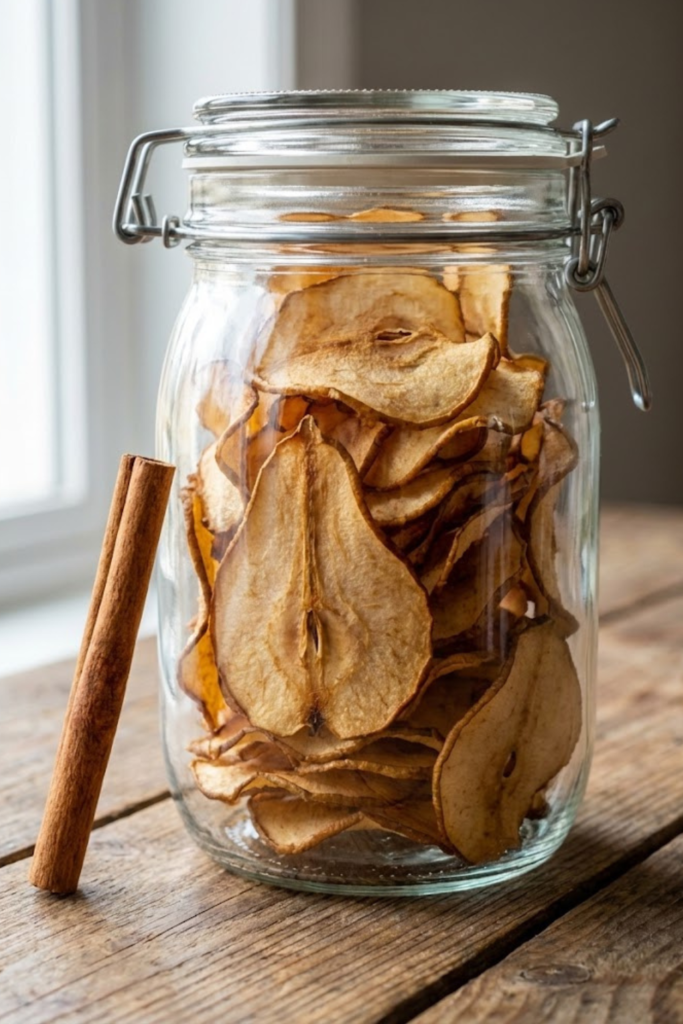
Once they are chilled, you need a good container. I’m a big fan of glass mason jars. There’s something about the way they seal that keeps the air out better than those cheap plastic tubs. If air gets in, the fruit will soak up the moisture from the kitchen air, and they’ll lose that “snap” we worked so hard for. I usually tuck a little piece of parchment paper at the top before I screw the lid on. It probably doesn’t do much, but it makes me feel better! Avoid using those thin sandwich bags because they aren’t airtight enough for long-term snacking.
Bringing the Crunch Back
Now, if you live somewhere humid or if someone leaves the lid off the jar (looking at you, honey!), they might get a little bit chewy after a few days. Don’t throw them away! You can actually “save” your baked pear cinnamon chips pretty easily. Just spread them back out on a baking sheet and pop them into a 200-degree oven for about ten minutes. It’s like a little refresh button for your snack. They’ll crisp right back up once they cool down again. It’s a great trick to have up your sleeve so you never have to deal with a sad, soft pear chip ever again. Usually, they stay good for about a week, but honestly, they never last that long at my place anyway!
Your New Favorite Healthy Habit
I’ve spent years trying to find snacks that actually make me feel good, and let me tell you, it hasn’t always been easy. As a teacher, my days are long, and by 3:00 PM, I’m usually reaching for whatever is in the breakroom. Usually, it’s a donut or some salty chips that leave me feeling tired an hour later. Switching to baked pear cinnamon chips changed that for me. It’s not just about the food; it’s about the habit of taking care of yourself. When you spend time making something from scratch, you appreciate it so much more. You know exactly what went into it—just fruit and a little spice—and there is a real sense of pride in that. It’s a small win in a busy day, and sometimes those small wins are the most important ones.
More Than Just a Snack
I think the reason I love these so much is that they satisfy that “crunch” craving without the guilt. Most of the stuff we buy in boxes is full of things we can’t even pronounce. But with these, you are just eating a pear that’s had the water taken out! My kids actually ask for these now, which is a huge victory in my book. I used to struggle to get them to eat enough fruit, but once I turned the fruit into “chips,” the game changed completely. It’s funny how a different texture can make something healthy seem like a treat. Plus, they make the whole house smell like a cozy autumn morning every time I make a batch, which is a nice little bonus for everyone.
Sharing the Love with Others
One of my favorite things to do is pack these into little bags for my fellow teachers or give a jar to a neighbor. It’s such a simple gift, but people really appreciate it because it’s homemade. In 2026, we all seem so busy and rushed, so giving someone something you actually took the time to bake means a lot. I’ve had people ask me for the “secret” to getting them so crispy, and I always tell them it’s just patience and a low oven! It’s a great way to start a conversation about healthy eating without being preachy about it. You just let the snack speak for itself.
Why This Recipe Sticks With You
Once you get the hang of picking the right pears and using your slicer, this becomes second nature. It’s a relaxing weekend activity that sets you up for success all week long. I hope you give this a shot and see how it fits into your life. It’s a simple change that makes a big difference in how you feel. There is something really satisfying about hearing that “snap” when you bite into a chip you made yourself. It reminds me that good things take time, and the results are always worth the wait.
If you loved this healthy snack idea, please share it on Pinterest so others can find it too!