Did you know that the average person consumes over 20 pounds of ice cream a year? I’m definitely contributing to that statistic! There is nothing quite like the nostalgia of a cold treat on a hot afternoon, but store-bought versions just don’t cut it anymore. I remember the first time I tried to make these; the ice cream squished out everywhere, and it was a total mess! But don’t worry, I’ve cracked the code. In this guide, we are going to craft the perfect cookie ice cream sandwiches that stay together and taste amazing. Get your napkins ready, because this is going to be delicious!

Choosing the Best Cookies for Ice Cream Sandwiches
Let’s be real for a second. There is nothing worse than biting into a homemade ice cream sandwich and having all the filling shoot out the back onto your shirt. I’ve ruined perfectly good white t-shirts that way. It’s a total rookie mistake I made constantly when I first started baking. I used to think any old cookie would do, but I was dead wrong.
After years of trial and error (and a lot of laundry), I realized that the structural integrity of the cookie is literally everything. If the cookie is too hard, the ice cream has nowhere to go but out. You need a specific texture to make this work.
The Softness Factor
For the best cookies for ice cream sandwiches, you have to aim for chewy, not crispy. When you freeze a cookie, it gets harder. If you start with a crunchy cookie, it turns into a rock in the freezer.
I remember making these thin, crispy ginger snaps for a holiday party once. I thought they would be elegant. Nope. Guests were literally gnawing on them like beavers trying to get to the ice cream. It was embarrassing.
Now, I always underbake my cookies by about one or two minutes. You want them to look slightly raw in the middle when you pull them out. This keeps them soft even when they are frozen solid. Soft batch chocolate chip cookies are the gold standard here because they stay pliable.
Thickness and Stability
You can’t just use a flimsy cookie, either. It needs to be sturdy enough to hold the weight of the ice cream scoop. I usually aim for a quarter-inch thickness.
If the dough spreads too much in the oven, you’re in trouble. A little trick I learned is to chill the dough for at least 30 minutes before baking. It stops the spread.
Also, try using a higher ratio of brown sugar to white sugar. Brown sugar has molasses, which adds moisture and keeps things dense and chewy. It’s a game-changer for frozen dessert recipes.
The Cool Down
Here is where I usually mess up because I have zero patience. You simply cannot assemble these while the cookies are even remotely warm.
I once tried to slap vanilla bean ice cream onto a cookie that had been out of the oven for ten minutes. It looked fine to the touch. But the residual heat melted the contact layer of the ice cream instantly. The top cookie slid right off like it was on a slip-and-slide. It was a hot mess.
You have to let them cool completely on the rack. Better yet, pop the cookies in the freezer for twenty minutes before you even think about assembly.
Flavor Matches
While we all love chocolate chip, don’t sleep on chewy oatmeal cookies. The texture of the oats adds a nice grip to the ice cream.
Just avoid anything with big chunks of hard candy or caramel bits inside the cookie itself. Those bits freeze into tooth-breakers. Stick to soft add-ins or consistent doughs.
Getting the cookie right is half the battle. Once you nail the texture, the rest is just assembly. Trust me, your laundry pile will thank you.

The Secret to the Perfect Ice Cream Filling
I used to think the ice cream part was the easy part. I mean, you just scoop it on, right? Wrong. I can’t tell you how many times I broke a perfectly good cookie trying to force a rock-hard scoop of vanilla bean ice cream between two delicate layers. It was heartbreaking. The cookie would snap in half, crumbs went everywhere, and I was left holding a sad, broken mess.
Over time, I learned that managing the ice cream melting point is actually the most critical skill here. If it’s too hard, you break the cookie. If it’s too soft, it runs down your arm before you can take a bite. It’s a delicate balance.
The Softening Strategy
You have to soften the ice cream, but you have to be careful. I usually leave the carton on the counter for about 10 to 15 minutes. It depends on how hot your kitchen is, obviously.
Don’t just walk away and forget it, though. I did that once while switching laundry and came back to soup. You want it to be the consistency of soft-serve. You should be able to press a spoon into it with zero resistance, but it shouldn’t look shiny or liquidy around the edges.
The Slice Method (My Favorite Trick)
If you take nothing else away from this post, let it be this tip. Stop using a scoop. Scoops create a ball shape that is terrible for stacking. When you press the top cookie down on a ball, all the pressure is in the center, which snaps the cookie.
Instead, I use the “slice method.” I grab a pint of ice cream—ben & jerry’s size works great—and I use a sharp serrated knife to cut right through the cardboard container. Yes, literally cut the carton into rounds.
You end up with these perfect, flat discs of ice cream. You just peel the cardboard ring off, place the disc on the cookie, and boom. Perfect structural integrity. It makes slicing ice cream pints feel like a magic trick. It looks so professional, and you barely have to touch the ice cream, so it stays cold.
Customizing Store-Bought Pints
Sometimes I don’t have the energy to make a full no-churn ice cream filling from scratch. That is totally fine. You can dress up a basic tub of vanilla.
I like to let the ice cream soften a bit more in a bowl and fold in my own mix-ins. Swirling in some strawberry jam or caramel sauce takes five seconds. Just don’t over-mix it, or you lose the air bubbles and it freezes back into a solid block of ice.
A Note on Dairy-Free
If you are working with dairy free ice cream options, be warned: they melt differently. Coconut milk-based ice creams tend to go from solid rock to liquid water very fast.
I learned this the hard way at a backyard BBQ. The almond milk ones hold up a bit better in the heat. If you are using dairy-free, keep them in the freezer until the very last second before serving. Don’t try to assemble a huge batch at once, or you’ll just be sad.

Assembling Your Cookie Ice Cream Sandwiches
Okay, this is where the rubber meets the road. Or I guess, where the cookie meets the cream. Honestly, assembling these things used to give me major anxiety. It is a race against the clock. The first time I tried to make a big batch for a block party, I ended up with a kitchen counter full of puddles. I was sweating almost as much as the ice cream was.
You have to be fast. Like, pit-crew fast. If you go into this without a game plan, you are going to lose.
The Setup
Before I even pull the ice cream out of the freezer, I make sure my station is ready. I line a baking sheet with parchment paper and clear a flat spot in the freezer.
This is a mistake I’ve made a hundred times: I assemble everything and then realize my freezer is jammed full of frozen peas and old pizza boxes. Then I’m standing there holding a melting ice cream sandwich assembly, trying to rearrange frozen chicken with one hand. Don’t be like me. Clear the space first.
The Gentle Squish
Once you place your ice cream disc (or scoop) on the bottom cookie, you have to add the top cookie. This is the danger zone.
My instinct was always to push down hard to get the ice cream to the edges. Bad move. I cracked so many cookies doing this. You have to do the “gentle squish.”
I place the top cookie on and use the palm of my hand to apply light, even pressure. Do not press with your fingers! Your fingers create pressure points that snap the cookie. Use your palm and twist slightly back and forth. It encourages the ice cream to spread without breaking the best cookies for ice cream sandwiches.
Cleaning Up the Edges
Even with the slice method, you might have some gaps or overhang. I keep a small offset spatula or even just a butter knife handy.
I run it around the edge of the sandwich to smooth out the ice cream. It makes them look like you bought them at a fancy bakery. If the ice cream is really soft, it might smear the cookie, so just work quickly. If it starts getting too messy, stop. Throw it in the freezer and fix it later. It is not worth the stress.
The Freezer Sprint
Here is the golden rule: Make one, freeze one.
Do not try to assemble a whole dozen and then put the tray in the freezer. By the time you finish the twelfth one, the first one is already melting.
I assemble one, toss it on the tray in the freezer, and then grab the next set of cookies. It’s a bit of a workout running back and forth, but it keeps the frozen dessert recipes actually frozen. Once they have been in there for about an hour, they harden up enough to wrap individually without making a mess.

Creative Toppings and Rolling Ideas
Honestly, a plain cookie sandwich is delicious on its own. But if you want to look like a pastry chef without actually going to culinary school, you have to roll the edges. It’s the oldest trick in the book. It hides all the imperfections. If your ice cream layer is a little lopsided, just smash some toppings into it. Problem solved.
I used to think this step was unnecessary fluff until I realized how much texture it adds. Plus, kids go absolutely bonkers for anything covered in colored sugar.
The Crunchy Roll
The first time I tried this, I held the sandwich in one hand and tried to sprinkle the toppings on with the other. What was I thinking? I had rainbow sprinkles in my floor grout for weeks. It was a disaster.
The right way to do rolling ice cream in sprinkles is to dump your topping onto a small, flat plate or a saucer. You want a shallow layer. Then, immediately after you squash the sandwich together—while the ice cream is still slightly tacky—roll it like a wheel through the toppings.
If you froze the sandwiches first, the toppings won’t stick. It’s like trying to glue glitter to a mirror. If they are already frozen solid, let the edges sit out for two minutes until they look a little shiny or wet. Then roll.
Getting Fancy with Chocolate
If you really want to show off, you can go for chocolate dipped frozen treats. This is my go-to for dinner parties because people think it’s way harder than it is.
Melt some semi-sweet chocolate chips with a teaspoon of coconut oil in the microwave. The oil thins it out and helps it create that “magic shell” crack when you bite into it. Dip half the sandwich into the bowl, let the excess drip off, then lay it on parchment.
I once dropped a whole sandwich into the bowl of warm chocolate. I fished it out, ate it over the sink, and started over. No regrets. It was the best mistake I made that summer.
Sweet and Salty Combos
Don’t just stick to the sweet stuff. My favorite thing lately is crushing up salty pretzels or even potato chips. The mix of sugar and salt is addictive. Sweet and salty desserts always hit the spot when it’s humid outside.
I’ve also been experimenting with pistachio rolling toppings on oatmeal cookies. It adds this nice, sophisticated green color and a great crunch. Just make sure you chop the nuts really fine. Big chunks just fall off and end up on the floor for the dog to find later.
Go wild with it. Use crushed cereal, mini M&Ms, or toasted coconut. Just remember to work fast, or you’ll end up with a topping soup.

Storing and Freezing for Later
You might be thinking, “Who has leftovers?” But trust me, you can’t eat ten of these in one sitting. I’ve tried. It ends with a stomach ache. So, you need to know how to store them without them tasting like freezer burn prevention later.
I used to just throw them all in a big Tupperware container together. Big mistake. They froze into one giant, inseparable brick. I had to use a chisel to get one out. It was ridiculous.
The Wrap Game
You have to wrap them individually. It’s a pain, but it is worth it. I rip off squares of plastic wrap or parchment paper.
I wrap each sandwich tightly, like a little present. This keeps the air out and stops them from absorbing that weird “freezer funk” smell. You know, that smell that old ice cubes get? You don’t want your homemade ice cream sandwich recipe tasting like last month’s lasagna.
How Long Do They Last?
Technically, they can last a month or two. But in my house? Maybe a week.
If you leave them in there too long, the cookie starts to get a little dry and crumbly. The ice cream gets icy crystals on it. So, I try to eat them within two weeks for the best flavor.
The Waiting Game
This is the hardest part. When you pull one out of the freezer, you cannot eat it immediately.
I learned this after chipping a tooth (okay, not chipping, but it hurt!) on a rock-hard sandwich. You have to let it sit on the counter for about 5 minutes. It lets the cookie soften up just enough so you can bite through it without unhinging your jaw. It’s the difference between a good time and a dental visit.
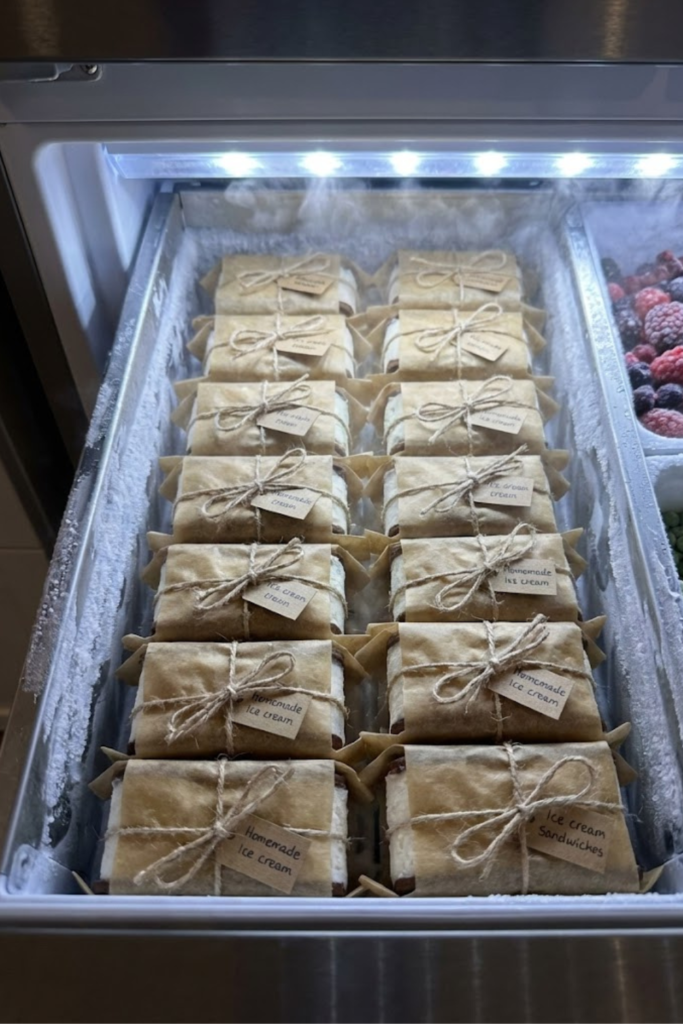
Making your own cookie ice cream sandwiches is honestly one of the most rewarding things you can do this summer. It beats the store-bought ones by a mile. Once you get the hang of the chewy cookie texture and the slice method for the filling, you’ll never go back.
It’s messy, it’s fun, and yeah, you might get some chocolate on your shirt. But that’s part of the charm! Whether you are making soft batch chocolate chip cookies or experimenting with crazy toppings, the effort is totally worth it.
If you found these tips helpful (and saved your t-shirts from ice cream drips), please share this post on Pinterest! It helps other home bakers find these tricks. Now, go check your freezer—you might have a sandwich ready to eat!