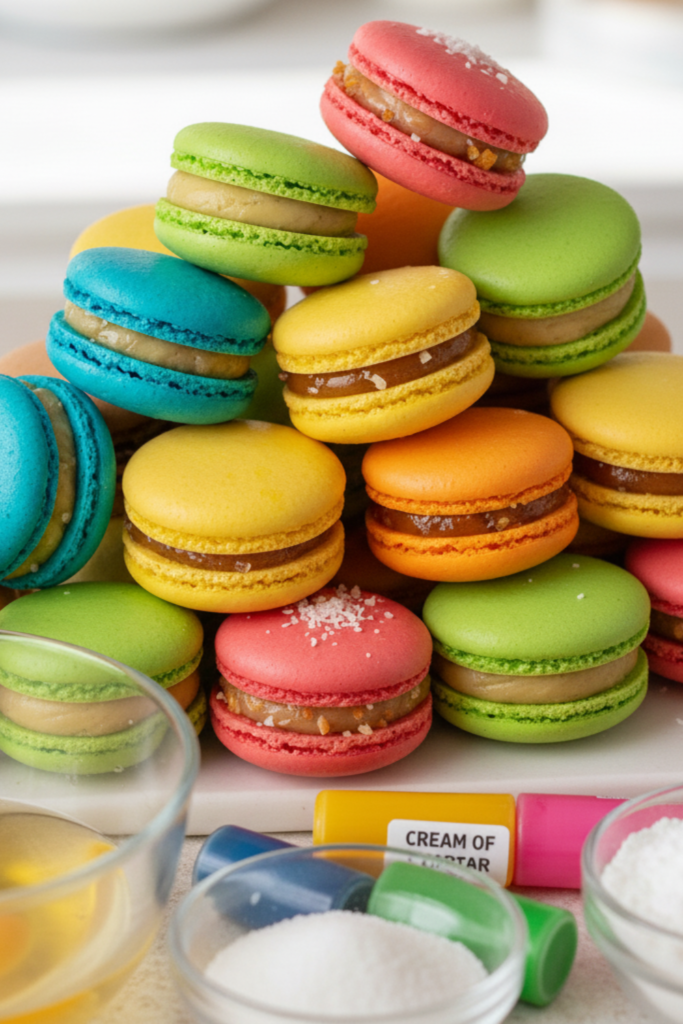
Welcome, fellow bakers, to the exquisite, sometimes frustrating, but always rewarding realm of French Macarons! I remember reading a baffling stat when I first started: over 75% of home bakers report failing their first batch of macarons. Doesn’t that just make you want to prove the statistics wrong? I know I did! These dainty, meringue-based sandwich cookies, with their crisp shell and chewy, luscious filling, are truly the prima donna of the bakery case. They are a gourmet treat. Sure, they have a reputation for being finicky, but I’m here to tell you that with the right knowledge and a few insider tricks, you can master these beautiful Parisian sweets. We’re going to walk through every single critical step, from aging your egg whites to perfecting that smooth shell, so you can confidently bake a flawless batch that will absolutely wow your friends and family. Get ready to tie on your apron and finally conquer the French macaron!
Essential Ingredients and Mis-en-Place for Macaron Success
Listen up, folks. When I first started making French Macarons, I thought I could just eyeball the measurements and use whatever almond flour I grabbed from the bulk bin. Boy, was I wrong! I’m talking about flat, grainy, cracked messes that looked like little alien hockey pucks, not those perfect macaron shells you see at the fancy patisseries. Making these dainty cookies is less about baking passion (though we have plenty of that!) and more about kitchen science. It’s a precision game, like surgery, and if you don’t have your ingredients and equipment lined up perfectly, you’re just inviting disaster. Trust me, I learned that one the hard way.
Weighing is Non-Negotiable (Seriously)
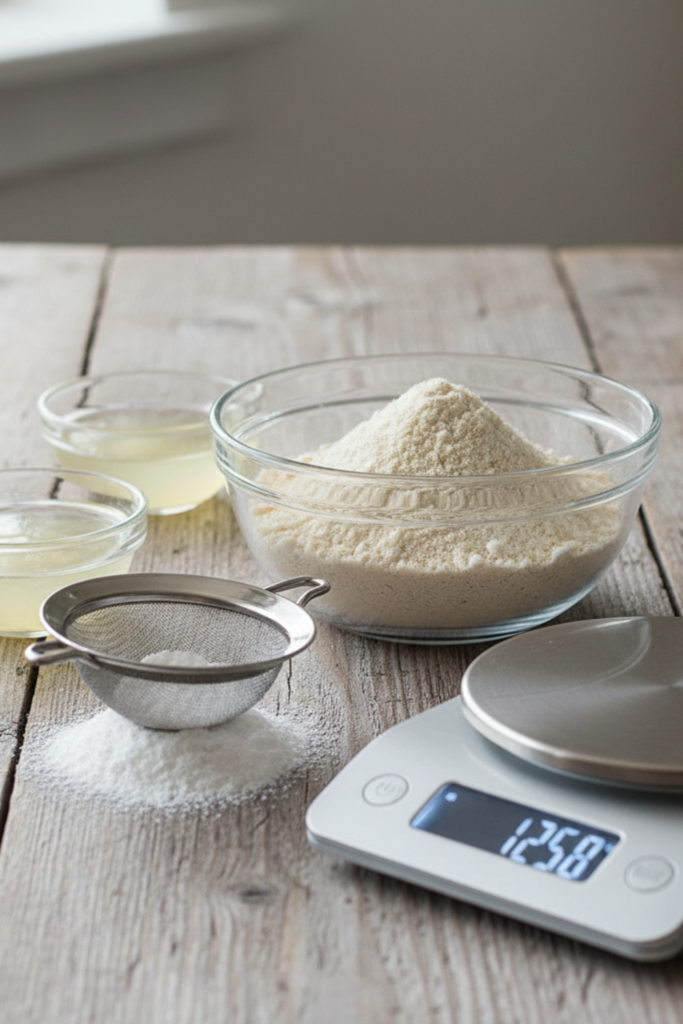
This might sound a little intense, but if you want to conquer the French macaron, ditch the cup measures immediately! Your volume measurements are all over the place, and these cookies are extremely finicky about ratios. I mean, did you know that the density of powdered sugar can change depending on the humidity? Crazy, right? My biggest breakthrough came when I finally invested in a good digital kitchen scale and switched to weighing everything in grams. When you see a recipe call for 100 grams of almond flour and 100 grams of powdered sugar, you’d better make that exactly 100 grams! I remember one time my scale batteries died mid-measurement, and I just guessed the last 10 grams of sugar. That batch of macaron shells came out totally uneven and sticky. I was so mad!
Almond Flour and Sifting – The Key to a Smooth Top
Okay, let’s talk flour. Don’t just grab any old ground almonds. For that beautiful, smooth top on your macaron shells, you absolutely must use super fine blanched almond flour. If you use almond meal, which still has the skins, or if the grind is too coarse, your finished shells are going to be bumpy and textured. Nobody wants that!
And here’s another step I tried to skip when I was new: sifting. You have to combine your almond flour and confectioners’ sugar (or powdered sugar) and run it all through a fine mesh sieve—sometimes twice. This process is called the “tant pour tant,” and it’s critical for getting rid of clumps and any stray large pieces of almond. Honestly, I often felt like my arm was going to fall off from all the sifting, but I tried to skip it once, and the tops of my cookies were speckled with little dark bits. I’ll never skip that step again, even if it’s a bit of a pain!
The Egg White Secret: Aging
This is probably the weirdest tip, but it works like a charm. To get a truly stable and robust meringue—which is what supports your shell—you need to use aged egg whites. This means separating your egg whites from the yolks and letting them sit, covered, in the fridge for 24 hours, or even just leaving them on the counter at room temp for a few hours. This process slightly dehydrates the whites, making the proteins stronger and capable of holding more air.
I had a friend who just used fresh egg whites, thinking it was a silly old-school rule, and her French macaron meringue always ended up weeping or breaking down. She had such a frustrating time with hollow macaron shells! Once she switched to aging her whites, it was like night and day. If you don’t have time to age them, you can also add a pinch of cream of tartar for stabilization, but aged whites are the real magic ticket. Just make sure your bowl is squeaky clean—any residual grease is a death sentence for your meringue. It’s seriously a lot of prep, but look, these are gourmet treats, they deserve the attention!
Mastering the Meringue: French vs. Italian Methods
Alright, so your dry ingredients are sifted, your egg whites are aged, and your kitchen is mostly clean. Good! Now we’re at the stage where things get truly interesting: the meringue. This is the backbone of your beautiful French Macaron, and if you mess it up here, it’s really hard to recover, I gotta tell ya. There are two main methods folks use, and honestly, each has its pros and cons. I’ve gone back and forth between them so many times, trying to find my happy place, but they both work when done right.
The French Meringue: The Classic, Fickle Approach
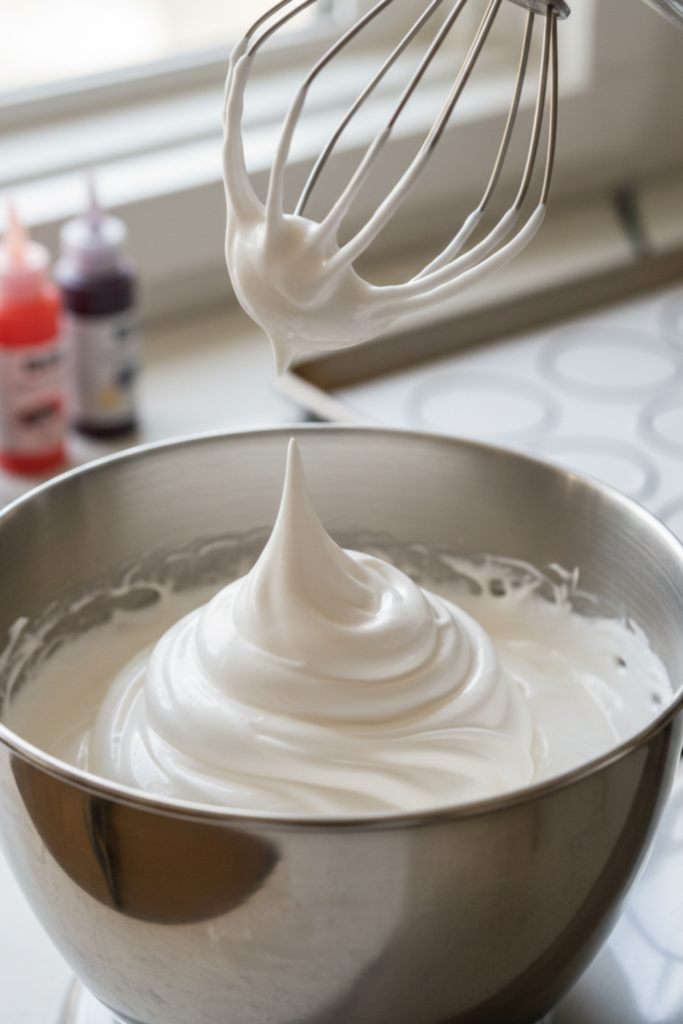
The French method is definitely the quickest and most straightforward. Essentially, you whip raw egg whites until they are foamy, and then you gradually stream in granulated sugar while the mixer is running. You keep whipping until you achieve what we call stiff, glossy peaks. The meringue should look super shiny, and when you lift the whisk, the peak should stand straight up and not flop over.
The big hang-up with this approach is that it is considered less stable. If you under-whip it, your macaron batter will be too loose and you won’t get those gorgeous, ruffled macaron feet. If you over-whip it, your meringue can turn grainy and dry. I made this mistake so many times when I was starting out! My tips for beginners? Be patient, use that cream of tartar for a little extra stability if you’re nervous, and stop whipping right when you hit the stiff peak stage—don’t go another thirty seconds!
The Italian Meringue: Stable, but More Effort
Now, the Italian method is what many professional bakeries and seasoned macaron enthusiasts swear by. Why? Because the meringue is incredibly sturdy, and it’s much more forgiving during the next step, the macaronage. The secret sauce here is the hot sugar syrup.
Instead of adding raw sugar to the egg whites, you boil sugar and a bit of water until it reaches a specific temperature—usually about $118^\circ C$ or $244^\circ F$. You then slowly pour this scorching hot syrup into already-whipped egg whites while the mixer is running. This actually cooks the egg whites, which is why it makes the meringue so stable! My first time trying Italian meringue, I accidentally splashed the hot syrup all over the side of the bowl instead of into the whites. I had to toss the whole thing! It was a frustrating and sticky mess, but it taught me that you need to pour slowly and right against the bowl’s side.
You do need a candy thermometer for this, which is an extra step, but man, the resulting Italian meringue gives you such a reliable base for those perfect macaron shells. If you’re a perfectionist who doesn’t mind a few extra steps, definitely try the Italian method. It really helps prevent those nasty cracked macaron tops you get when the meringue isn’t strong enough.
The Stiff Peaks Visual Test
Regardless of which meringue-based confection method you pick, the test is the same: lift that whisk! The meringue should hold its shape and look like bright, white, stiff horns pointing straight up. When you pinch a bit between your fingers, you shouldn’t feel any grit, which means your granulated sugar is fully dissolved. Getting this part right is, like, eighty percent of the battle, seriously. If you nail the meringue, you’ve got a fantastic shot at those chewy, delicate sweets.
The Art of Macaronage: Achieving the Perfect Batter Consistency
Welcome to the most stressful and yet most rewarding part of baking French Macarons! Seriously, I used to get major anxiety right here. This single step, called macaronage, is where you mix your gorgeous meringue with your sifted dry ingredients—the almond flour and powdered sugar. The goal isn’t just to mix them; the goal is to gently knock just the right amount of air out of the meringue so the batter reaches the perfect, smooth flow. If you mess this up, you end up with either crunchy, misshapen shells or a flat, runny mess. It’s truly an art form!
The Danger of Undermixing
When you first start folding the ingredients together, it’s going to look like a clumpy, dry mess. A lot of beginners get scared here, thinking they’re going to overmix, so they stop too early. I’m guilty of this, too! I remember a batch where I stopped way too soon because I was terrified of knocking out the air. The result? My piped macaron shells had pointy tips that wouldn’t flatten out, and they got terrible cracked macaron tops in the oven. If the batter is undermixed, it’s too thick, and it can’t spread properly. So, you have to keep folding past that point where it looks like it’s just combined.
The Molten Lava Flow: The Figure-Eight Test
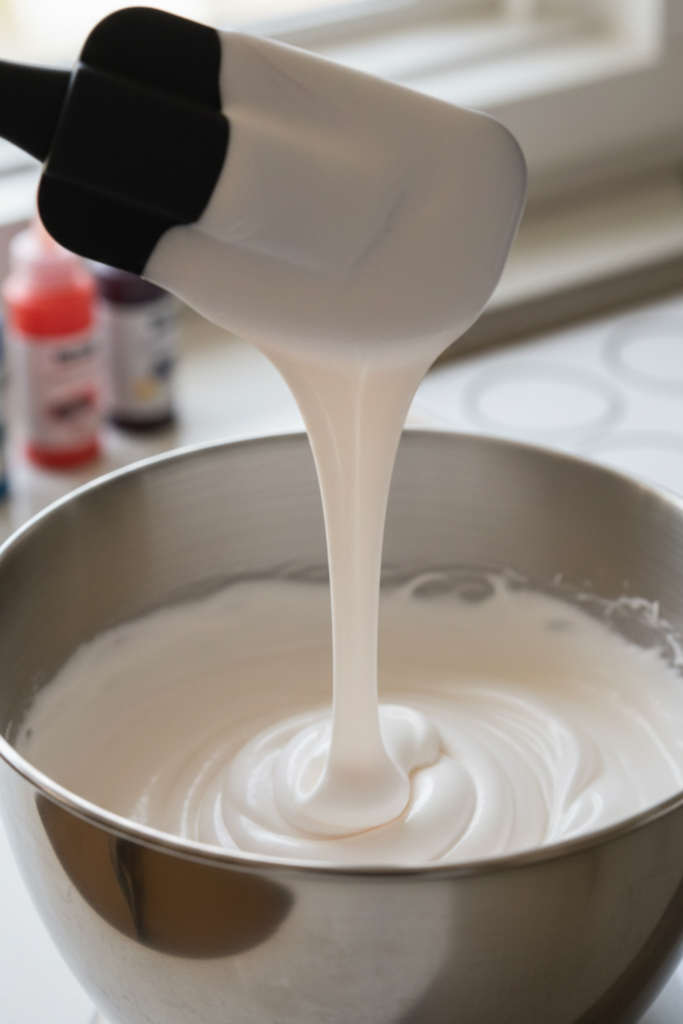
This is the golden rule, the secret handshake, the one visual cue you need to master! The proper consistency for macaronage is often described as the “ribbon stage” or “molten lava” flow. The batter needs to be runny enough to flow off your spatula in a thick, slow, continuous ribbon.
The best way to test this is the figure-eight test. You scrape up a good amount of batter and let it stream off the spatula. You should be able to draw a continuous figure eight with the falling batter without it breaking. Once you complete the figure eight, the ribbon should sink back into the rest of the batter in the bowl within about 10 to 30 seconds. I usually count to myself: “One thousand one, one thousand two…” If it takes much longer than that, you need a few more folds. If it melts instantly, you’ve gone too far, which brings us to the biggest fear.
The Catastrophe of Overmixing
If the macaronage is taken just one minute too far, your batter will become too loose and runny—it’s like soup!. The air structure collapses, and there’s no way to get it back. When you pipe this runny batter, it will spread out immediately, you’ll never see any macaron feet rise, and you’ll end up with flat, brittle discs. It is heartbreaking when it happens, seriously!
My practical tip, learned through sheer frustration, is to use a large, flexible rubber spatula and fold in wide, sweeping motions. Scrape the sides of the bowl, scoop the batter, and turn the bowl as you fold. Do about 10 folds, test the consistency, do another 5 folds, test again, and so on. You must stop folding the second you hit that perfect, continuous ribbon flow. Once you’ve mastered this delicate balance, you’re basically a macaron expert!
Piping, Resting, and Baking: The Macaron “Foot” Formula
We’ve mixed the batter, and it’s flowing like thick, beautiful lava. Now we need to get it onto the tray and into the oven! This stage is crucial because it’s all about creating the perfect environment for the shell to separate from the foot as it bakes. If you’re stressed about this part, don’t be. Just stick to the steps, and you’ll be fine!
Piping for Perfect Circles
First things first: piping. I always recommend using a template—either one you print out or one you draw yourself—underneath your silicone baking mat or parchment paper. This helps you get consistently round, uniform circles, which is important for matching the shells when you assemble the French Macarons. You should use a piping bag fitted with a large round tip (like an Ateco 804 or similar).
When you pipe, hold the bag straight up, perfectly perpendicular to the baking sheet. Pipe until the batter fills the template circle, then quickly flick the bag sideways to stop the flow. My early mistake was trying to pipe slowly or unevenly, and I ended up with weird, lopsided ovals. Precision and a steady hand are what’s up here!
Releasing the Air (The Tray Rap)
Immediately after piping, you need to firmly rap the baking sheet on the counter—maybe four or five good smacks. Don’t be gentle! This is a necessary step to release any large air bubbles trapped inside the shell. If you skip this, those bubbles will expand during baking, and boom—you get cracked macaron tops. If you see little surface bubbles after the rap, use a toothpick to gently pop them and smooth the surface. I once thought I rapped the tray hard enough, but apparently not, because half the tray came out looking like they had tiny volcanoes on top. Never again!
The Resting Period (Croutage)
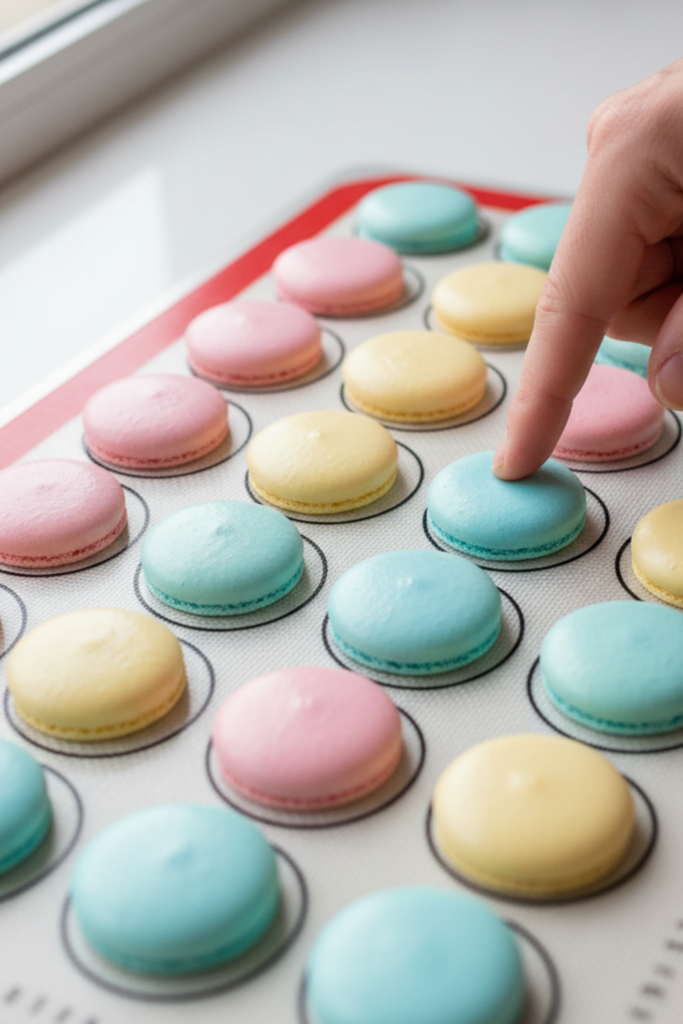
Now we rest. This is called croutage, and it’s the period where a “skin” forms on the outside of the piped shell. The shell must rest at room temperature until the top is dry to the touch—you should be able to lightly run your finger across it without any batter sticking to you. This process can take anywhere from 30 minutes to over two hours, depending on the humidity in your kitchen. I live in a humid area, so I sometimes point a fan at them to speed things up!
Why do we do this? When the shells are baking, the crust prevents the air from escaping through the top. Instead, the trapped hot air pushes the unbaked batter up and out through the bottom, creating the iconic pied or macaron feet. No skin, no feet—simple as that!
Baking Temperature is King
When it’s time to bake, temperature is absolutely vital. Most home ovens are wildly inaccurate, so please, please use an oven thermometer. You are looking for a lower temperature, usually between $285^\circ F$ and $315^\circ F$, depending on your oven. I also use a double-pan method (one baking sheet stacked on another) to help insulate the bottom and prevent the bottoms of the macaron shells from browning too quickly. The goal is a steady bake that gives the macaron feet time to rise evenly. It’s a delicate dance, but the reward is a tray of perfectly risen, beautiful macarons!
Awesome! The hard work of getting those beautiful shells baked is done. Now for the really fun part—making them taste amazing and getting that final, perfect texture!
Flawless Fillings and Macaron Maturation
You have a tray of beautiful, perfectly risen macaron shells with those gorgeous macaron feet. Don’t touch them yet! They must cool completely on the mat before you even think about peeling them off, or you’ll tear the bottoms right off—I know that pain well. Once they’re cool, it’s time to fill these delicate, sweet treats and wait for the magic to happen.
Choosing Your Signature Filling
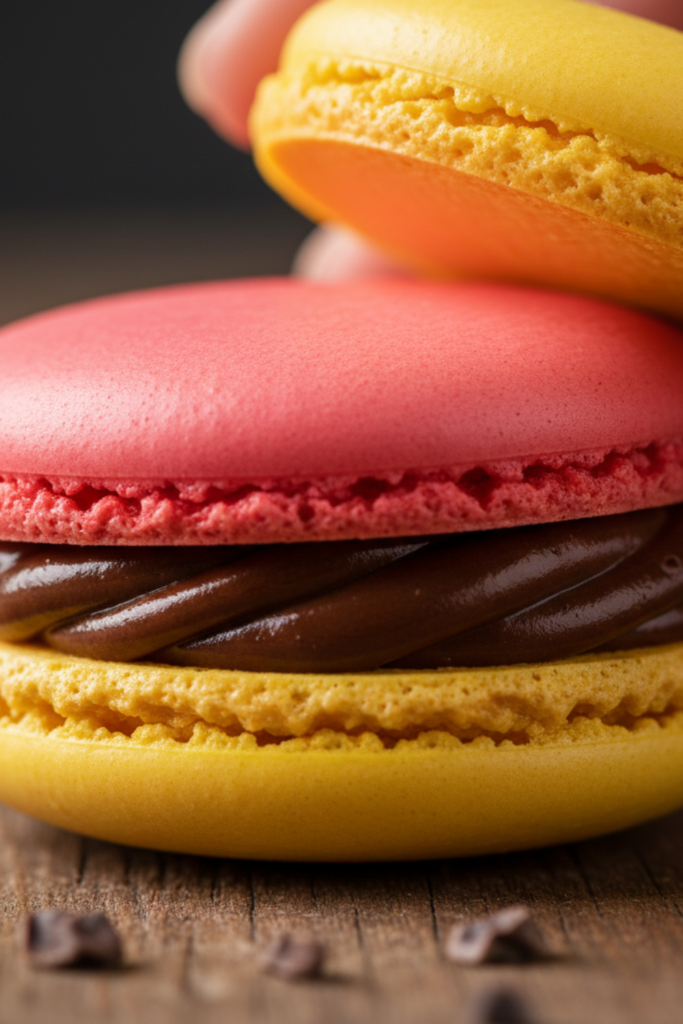
The right filling does two jobs: it provides incredible flavor and, critically, it provides the moisture needed for the final stage. The classics are classics for a reason! You can go with a rich chocolate ganache, a fluffy buttercream filling (Swiss or Italian are fantastic), or something bright like lemon curd or a thick fruit jam.
I find that a good buttercream filling is easiest for beginners because it holds its shape really well when piping. I had this moment of triumph once when I made a salted caramel buttercream—it was like a symphony in my mouth! You just need to make sure your filling isn’t too runny, otherwise, it will squeeze out the sides when you try to sandwich the shells, making a mess and potentially ruining the final texture.
Shell Matching and Assembly Tips
Okay, you’ve got two heaps of cooled shells. Now, this takes a minute, but it’s worth it: match them up! Pair shells that are similar in size and shape. Since we’re human, they probably won’t all be identical, but try to find their twin.
Load your filling into a piping bag and pipe a neat, centered mound of filling onto the flat side of one shell. It should be about the size of a pecan—enough filling that when you place the second shell on top and gently press, the filling spreads right to the edges, but doesn’t squish out. Don’t twist the shells together! Just place them gently.
The Macaron Maturation Process—You Must Wait!
This is the hardest part, because your French Macarons are assembled and look perfect, and you want to eat one right away! But you must wait. This waiting period is called maturation, and it’s non-negotiable for achieving that signature soft, chewy interior.
During maturation, the assembled macarons are refrigerated in an airtight container for at least 24 hours. What happens is the moisture from the filling slowly seeps into the brittle macaron shells, softening them up. If you eat one immediately, the shell will be crispy and brittle, almost hollow. After 24 hours, they magically transform into that delicate, soft, melt-in-your-mouth perfection we all crave. I was so impatient with my first batch that I tried one after just four hours, and it was hard! I learned my lesson: patience truly is a virtue in the realm of macarons.
Once they are fully matured, they can be stored in an airtight container in the fridge for several days, or they freeze beautifully too. Now go enjoy your incredible, bakery-quality French Macarons!
Conclusion: Your Macaron Triumph Awaits!
Wow, we covered a lot of ground, didn’t we? From carefully weighing your almond flour and aging your egg whites to finally achieving that perfect ribbon consistency during macaronage, you now have all the tools to transform your macaron attempts into genuine success. Remember, the journey to the perfect French macaron is less about luck and much more about precision, patience, and practice! Don’t be discouraged by an imperfect first tray—even the pros occasionally have an off batch. But when you finally get that smooth shell, the iconic pied, and the chewy interior, you’ll know all the effort was absolutely worth it. Now go forth, bake a beautiful batch, and don’t forget to show off your glorious Parisian cookies!
Action Step: Share your success! When you finally achieve your first perfect macaron shell, snap a pic and share it on Pinterest so the rest of the world can see your beautiful creation!